
PVC Ablation in Los Angeles
A focused catheter procedure for frequent extra heartbeats, considered only after your electrophysiologist explains your monitor results and every other option.
Why people choose PVC ablation
Skipped or thumping heartbeats
Extra beats throughout the day
Fatigue or reduced stamina
Concern about heart pumping strength
Most PVCs need no procedure, but when they are frequent and troublesome, ablation may help.


Your own doctor reads your monitor and treats you
The electrophysiologist who reviews your Holter results is the one who decides with you whether ablation makes sense, performs it if needed and checks your progress afterward.
- Fellowship-trained in cardiac electrophysiology
- Reassurance when no procedure is needed
- Monitor reviews with the same physician
How PVC ablation works
Measuring your PVCs
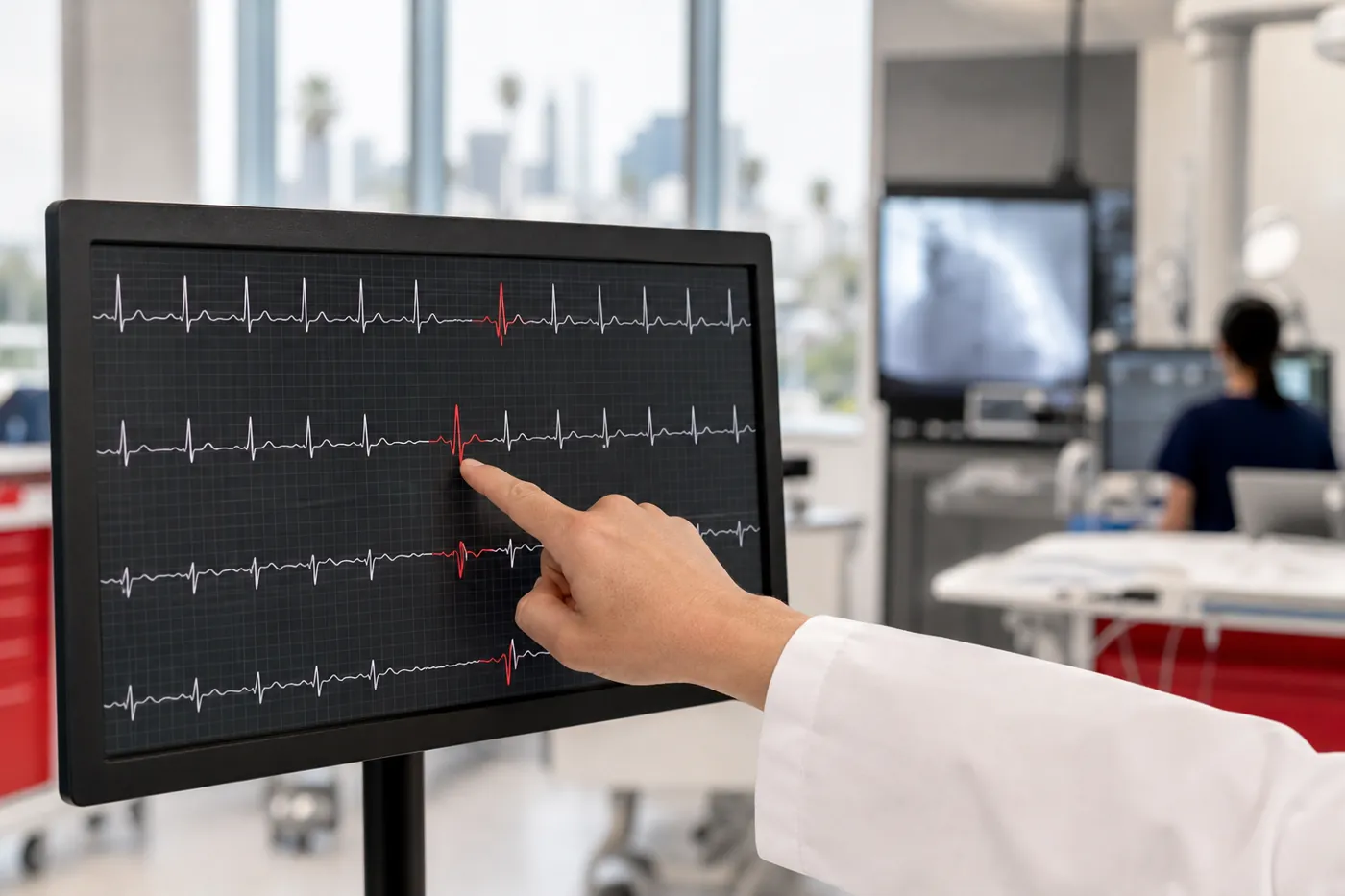
A wearable monitor counts how often PVCs happen and shows their shape on the ECG.
Finding the source
Catheters map the heart to find the earliest spot where each extra beat begins.
Treating that spot
Energy is applied to the small area that is firing early.
Rechecking your rhythm
A repeat monitor and follow-up visit show how much your PVCs have settled.
PVC ablation may be a good fit if
- Your PVCs are frequent on a monitor
- Symptoms persist despite medicine
- PVCs may be weakening your heart muscle
Other options we’ll discuss
Understanding PVC ablation
What PVCs are
Premature ventricular contractions (PVCs) are extra heartbeats that start early in the lower chambers. The beat after a PVC often feels stronger, which is why many people describe a skip, flip or thud in the chest.
Some people feel PVCs mostly at rest or when lying down at night, when there is less to distract them. Others notice them during or after exercise. When they happen, and how they feel, are worth noting for your physician, because patterns can help guide testing.
PVCs are very common, and many people have them without knowing. In a healthy heart they are often harmless. An electrophysiologist helps you sort out whether yours need treatment or simply an explanation.
When treatment is considered
Treatment usually becomes a question when PVCs cause symptoms that affect daily life, or when they are very frequent. In some people, a large number of PVCs over time can weaken the heart’s pumping. This is called PVC-induced cardiomyopathy, and it may improve when the PVCs are reduced.
First steps often include checking for triggers such as poor sleep, stimulants or thyroid problems, along with an echocardiogram to look at heart structure. Some people also try medicines such as beta blockers. Our guide on caffeine and heart rhythm covers one common question.
Measuring how often PVCs happen
A Holter or patch monitor worn for one or more days counts your PVCs and records their shape. That shape gives clues about where in the heart they start.
Many PVCs come from one small area, often the outflow tracts where blood leaves the heart. When most of your PVCs look the same on the ECG, they likely share one source, which makes a focused ablation more practical.
Living with PVCs while you decide
Feeling extra beats can be stressful, and stress can make you notice them more. Knowing that your heart structure is normal often brings real relief. Our guide on heart rhythm and anxiety explains this link.
Steady sleep, regular exercise that your physician approves and limits on stimulants help some people feel fewer PVCs. These steps will not suit everyone, but they cost little to try. Keep a short diary of when your extra beats are worse, since patterns can point to triggers.
If you are thinking about ablation, write down your questions before your visit. Ask what your monitor showed, where your PVCs likely start and what would happen if you chose to wait.
What happens during the procedure
Thin catheters are guided into the heart through a vein, and sometimes an artery, at the top of the leg. Your electrophysiologist maps the heart to find the spot that fires earliest during each PVC, then applies energy there.
Because the map depends on catching PVCs as they happen, your care team may ask you to pause certain rhythm medicines beforehand. Only do this on your physician’s instructions. Lighter sedation is often used, since deep sedation can quiet the PVCs during the procedure.
Recovery and follow-up
You can often leave the same day or after one night. Expect some tiredness and bruising where the catheters went in. Your physician will advise when you can drive, lift and exercise.
A repeat monitor is usually arranged a few weeks or months later to see how much your PVCs have decreased. If PVCs had weakened your heart, a follow-up echocardiogram can show whether its pumping has recovered.
Risks
PVC ablation is a well-established procedure. Bruising or bleeding at the catheter site is the most common issue. Rarer risks depend on where the PVCs start and include injury to the heart, nearby blood vessels or the heart’s normal wiring. Your physician explains how your PVC location affects your own risks.
Questions about PVC ablation
Are PVCs dangerous?
In a structurally normal heart, PVCs are usually not dangerous, even when they feel unsettling. They deserve a closer look when they are very frequent, when you have other heart disease or when they come with fainting. Call 911 for fainting, chest pain or severe shortness of breath.
How many PVCs is too many?
There is no single number that applies to everyone. Your physician looks at how often PVCs happen across a full day, how you feel and how well your heart is pumping. These together guide whether treatment is worth considering.
What if my PVCs do not appear during the procedure?
PVCs can be unpredictable, and sometimes they quiet down in the lab. Your physician may use medicine or pacing to bring them out. If they still cannot be found, mapping may be limited, and your physician will discuss what comes next.
Will I still feel extra beats afterward?
Some people notice occasional extra beats after ablation, and some PVCs may come from a different spot. The goal is to reduce frequent, bothersome PVCs, not to remove every single extra beat. A follow-up monitor shows how much has changed.
Do I need ablation, or will medicine work?
Many people do well with reassurance, lifestyle changes or medicine. Ablation is usually considered when those steps are not enough or not tolerated. Your electrophysiologist will walk you through each choice, and you can talk to them before changing any medicine.